Hotel Room Types Explained: What Is a Suite?
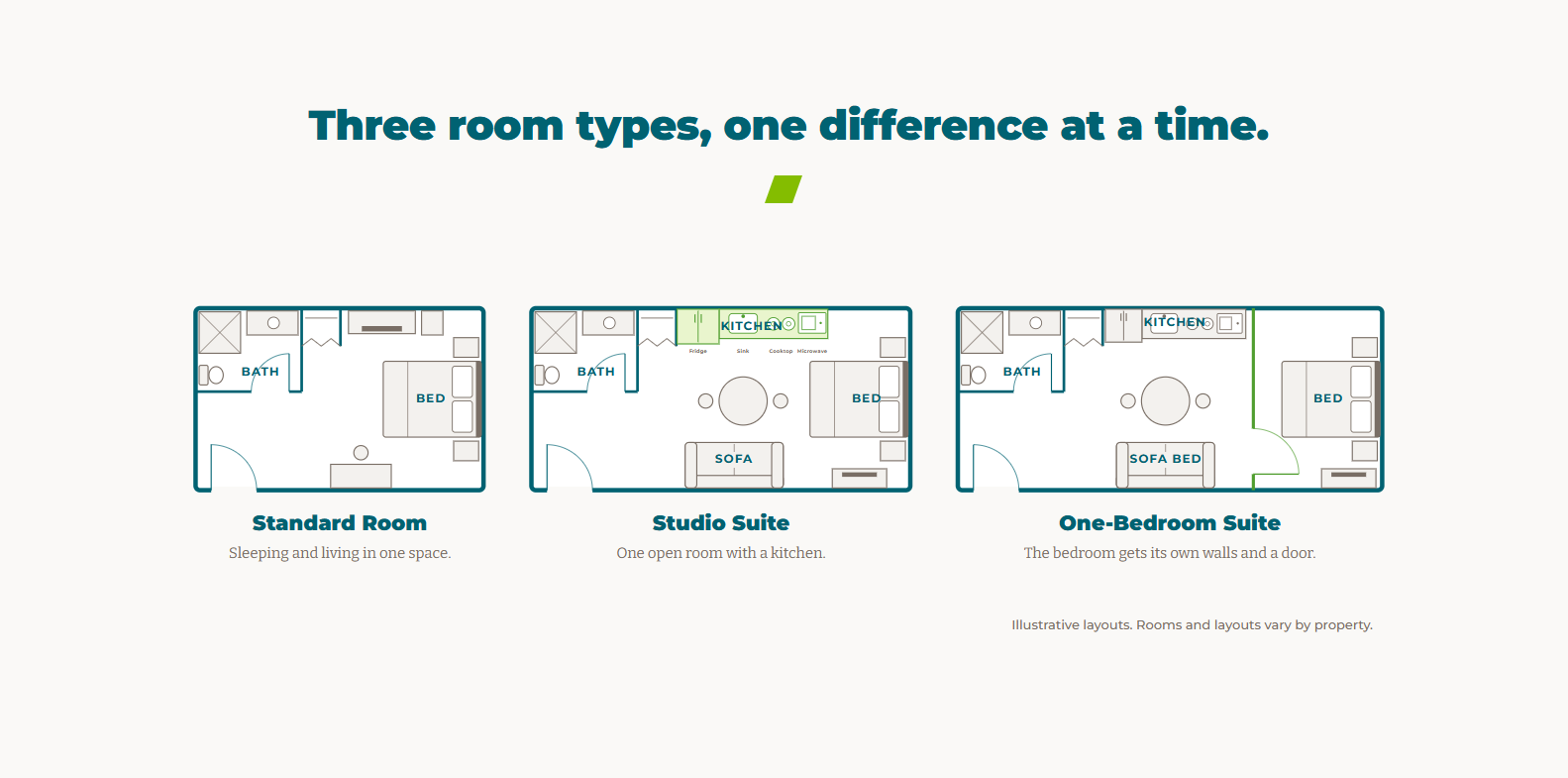
A suite is a hotel room with a living area separate from the sleeping area. That separation is the whole definition. Everything else about it (size, kitchen, view, floor) varies by property.
If you searched “what is a suite” from the middle of a booking page, you're the typical reader here, and the vocabulary is simpler than it looks. Every label comes down to three things: whether the bedroom is walled off, how many people the room holds, and whether it has a kitchen. This guide decodes all of it, including which room type makes sense when you're staying a week or more.
What Is a Suite?
A suite separates the living space from the sleeping space, usually with a wall and often with a door. Many suites add a kitchenette or a full kitchen, and most offer more square footage than a standard room at the same property.
One caution before you book: “suite” in a hotel's name doesn't guarantee that every room in the building has a separate bedroom, and some rooms sold as suites are open studio layouts. The room description settles it. Read that rather than the sign.
The Three Things That Actually Differ Between Room Types
Separation. The core question is whether the bedroom is walled off from the living area. An open room where the bed, the sofa, and the table share one space is a standard room or a studio. A walled bedroom with its own living room is a suite. Nearly every label you will meet is describing a point on that line, and it is also the entire difference between a room and a suite: a standard room keeps everything in one space, while a suite gives the living area its own.
Space and occupancy. Square footage drives how many people can stay, and the rate usually assumes a specific number of guests (that's what “double occupancy” means; more on it below). Occupancy limits are set per room by the property and by safety codes, so two rooms with the same name at different hotels can hold different numbers of people.
Kitchen. Rooms come with no kitchen, a kitchenette (mini fridge, microwave, sometimes a small cooktop), or a full kitchen (full-size refrigerator, stovetop, real counter space). For a night or two the difference barely matters. For a month it decides your food budget.
The three most common room types line up on those axes like this:
| Feature | Standard Room | Studio Suite | One-Bedroom Suite |
|---|---|---|---|
| Layout | Bed and living in one space | One open room with a defined living area | Bedroom walled off from the living room |
| Kitchen | Rarely; sometimes a mini fridge | Kitchenette or full kitchen | Kitchenette or full kitchen |
| Typical occupancy | 1 to 2 guests | 1 to 2 guests, with more room to live | 2 to 4 guests, depending on the sofa bed |
| Best for | A few nights | Weekly and monthly stays | Families, or guests who want a door to close |
These are patterns rather than guarantees. Layouts, kitchen contents, and occupancy limits vary by property, so confirm the details for the specific room you're booking.
Standard Rooms, Doubles, and What “Double Occupancy” Means
A standard room puts sleeping and living in one space: a bed or two, a chair or a small desk, a bathroom, sometimes a mini fridge. It's the default room type at most hotels and a perfectly good answer for a short stay.
“Double room” is where the vocabulary gets sloppy, and the industry has earned the confusion. At some properties a double room means one double bed. At others it means two beds. The label alone won't tell you which; the bed listing in the room description will.
While we are on beds: a double and a full are the same mattress, about 54 inches wide. A queen is 60, a king is 76. Two adults fit on any of them; two adults sleep noticeably better on a queen or a king. When a listing says two double beds, it means two full-size beds, which is the classic family setup.
“Double occupancy” is a different term doing a different job. It describes the rate, and it means the price assumes two guests sharing the room. It does not mean only two people are allowed. A third guest is often fine up to the room's maximum, though some properties add a per-person charge past two.
Sofa beds count toward occupancy and solve the fourth-guest problem, but they are a different sleeping experience from a real mattress. For a weekend, nobody minds. If someone in your group will be on that pullout for three weeks, ask the property what the sofa bed is actually like, or price a two-bedroom suite or a second room instead.
So how many people can stay in one hotel room? The common pattern is two guests per bed, plus whatever a sofa bed adds, with the ceiling set by the property and local fire codes. A king standard room is usually a two-person room; a one-bedroom suite with a queen and a sofa bed often lists a maximum of four. Treat those as patterns. Check the stated maximum on the room you want, and call the property if your group is right at the line.

What Is a Studio Suite? (The Extended-Stay Room)
A studio suite combines sleeping and living space in one open room and adds a kitchenette or a full kitchen. There's no wall between the bed and the sofa. There is a kitchen where a standard room would have a dresser.
The layout exists for a specific kind of guest: someone living in the room for weeks rather than visiting for nights. A traveler on a two-night trip barely touches a kitchen. A guest on a six-week assignment uses it three times a day, and cooking instead of ordering out is usually the biggest single saving of a long stay (the numbers are in our guide to what a weekly or monthly stay costs). The studio delivers that kitchen, plus space to actually live in, at a price below a walled-off suite, because you are not paying for a second room.
That's why the studio suite is the workhorse room at extended-stay hotels, where it pairs with weekly billing and on-site guest laundry.
If you're comparing studio suites across properties, the kitchen details separate them more than square footage does. A full-size refrigerator changes how you grocery shop. A cooktop versus a microwave changes what you can cook. Counter space decides whether meal prep is pleasant or an exercise in balancing cutting boards. Room descriptions usually list the appliances, and the front desk can fill in whatever the listing leaves out.
At WoodSpring Suites® hotels, guest rooms are studio-style suites with in-room kitchens, typically including a stovetop, a microwave, and a refrigerator, along with space to sleep, eat, and work. Layouts vary by location, so check the room details for the property you plan to book.

Junior Suites, One-Bedroom Suites, and Bigger
A junior suite sits between a studio and a full suite, and in practice it overlaps with the studio heavily: one large open room with a defined sitting area, sometimes a partial divider, no full wall. Some properties use the two terms interchangeably. If the description doesn't say “separate bedroom,” assume the room is open.
Booking photos can settle the separation question faster than the label can. Look for an interior door in the frame, or a shot taken from the living area where the bed is out of sight. If every photo shows the bed and the sofa together, you are almost certainly looking at an open layout, whatever the room is called.
A one-bedroom suite adds the wall and, usually, the door. That's the room to book when privacy is the point: a couple traveling with a child, someone working odd hours while a partner sleeps, or anyone who wants to shut the door on the day.
For a long stay, choosing between a studio and a one-bedroom suite mostly comes down to who's in the room. One person, or a couple keeping the same hours, will find the studio does the job and costs less, and over two months that difference compounds. Add a kid, a night-shift schedule, or a job that lives on video calls, and the wall starts earning its price.
Two-bedroom suites exist, and the families searching for them outnumber the hotels that offer them. They're most common at extended-stay and apartment-style properties and rare at standard hotels. Where a property doesn't have one, the honest alternatives are connecting rooms (two rooms joined by an interior door; request them when booking, since most hotels can't guarantee the connection until check-in), adjoining rooms (side by side, no interior door), or simply booking two rooms near each other.
Above all of this sits the luxury taxonomy (presidential suites, penthouses, cabanas), which mostly matters at resorts and is a different conversation.

“Deluxe,” “Superior,” and Other Labels That Mean Whatever the Hotel Wants
“Deluxe,” “superior,” “executive,” and “premium” are not regulated terms. No industry body defines them, and nothing stops one property's superior room from being smaller than another property's standard. In practice they tend to signal a higher floor, a better view, or a newer renovation, but the word itself guarantees nothing.
So compare the parts that are concrete: the square footage, the bed listing, whether the bedroom is separate, and what the kitchen includes. A room description that gives you those four facts has told you everything the adjective was gesturing at.
Frequently Asked Questions About Hotel Room Types
What is a suite in a hotel?
A suite is a hotel room with a living area separate from the sleeping area, usually divided by a wall and often a door. Many suites add a kitchenette or a full kitchen. The separation is the defining feature; size, layout, and kitchen contents vary by property.
What is a studio suite?
A studio suite combines sleeping and living space in one open room, typically with a kitchenette or a full kitchen. It's the signature extended-stay layout, built for guests living in the room for weeks, with more function than a standard room at a lower price than a walled-off suite.
What is the difference between a junior suite and a suite?
Separation. A junior suite (sometimes called a studio suite) is one large open room with a defined sitting area. A full suite physically divides the bedroom from the living room with a wall and usually a door. If a private bedroom matters to you, book the full suite.
What does double occupancy mean?
It means the rate is priced for two guests sharing the room. More guests can often stay, up to the room's stated maximum, though some properties add a per-person charge beyond two. Maximums are set by the property and safety codes, so confirm the limit when booking.
How many people can stay in one hotel room?
It depends on the room's maximum occupancy, which the property sets with local safety codes in mind. A common pattern is two guests per bed plus any sofa-bed capacity. Suites hold more people comfortably than standard rooms. Check the stated maximum when booking rather than assuming.
Do hotel suites have kitchens?
Many do, especially at extended-stay hotels, where studio suites include a kitchenette or a full kitchen as standard. At a traditional hotel, a suite may offer only a wet bar or a mini fridge. Check the room description for the specific appliances; the word suite alone doesn't guarantee a kitchen.
Booking a room for a week or more? Find a WoodSpring Suites location near you and look at the studio suite layouts for your dates.